

No Chimney? How to Enjoy an Antique Fireplace in Any Home
One of the questions we hear most often in the showroom is a simple one: “I’d love a fireplace, but my home doesn’t have a chimney. Is that the end of it?” The answer, happily, is no.
A great many London homes have lost their chimneys over the years. Breasts were removed in Victorian terraces to gain floor space, stacks were capped, and new-build flats and lateral apartments were often designed without one at all. Yet the desire for a fireplace as the centrepiece of a room has never gone away.
Today, an antique or bespoke chimneypiece can be installed almost anywhere, with a modern fire sitting behind it that needs no traditional chimney. Here is how it works.
Start with the Chimneypiece
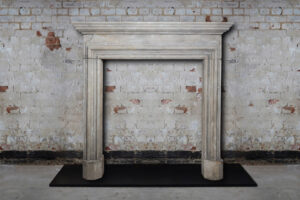 We always encourage clients to choose the surround first. The chimneypiece is what defines the room: its period, its proportions and its material set the tone for everything around it.
A restrained Georgian marble surround with fluted jambs suits a tall, well-proportioned drawing room. A carved French stone mantel brings warmth and weight to a larger space. A slim bolection frame can sit comfortably in a contemporary apartment. Once the surround is chosen, the fire itself is selected to fit the opening and the building.
This order matters. Starting with the fire often leads to compromises in the look of the room. Starting with the chimneypiece means the technical solution is designed around the piece you love, not the other way round.
What Sits Inside: Your Fire Options
Without a conventional chimney, there are still several ways to bring real flame or a convincing glow into an antique surround.
Balanced flue gas fires. These draw air in and send gases out through a single concentric pipe, usually through an external wall directly behind the fire. They give a genuine live flame, are sealed behind glass and are very efficient. They suit rooms on an outside wall.
Powered flue gas fires. Where the fire sits away from an outside wall, a small fan can push the flue gases along a longer route to a suitable exit point. This opens up internal walls and more awkward layouts.
Flueless gas fires. These use a catalytic converter to clean the combustion gases, so they need no flue at all. They do require adequate room size and ventilation, and suit some rooms better than others.
Electric fires. Modern electric fires have improved enormously, with realistic flame effects that sit well within a traditional opening. They need only a power supply, making them ideal for flats and upper floors.
Bioethanol fires. These burn a liquid fuel with a real, clean flame and need no flue or gas connection. They are best treated as decorative rather than as a main heat source.
| Option | Needs a flue? | Real flame? | Best suited to |
|---|---|---|---|
| Balanced flue gas | Through an outside wall | Yes | Rooms on an external wall, access to the roof |
| Powered flue gas | Fan-assisted route | Yes | Internal walls, complex layouts |
| Flueless gas | No | Yes | Well-ventilated, larger rooms |
| Electric | No | Flame effect | Flats, upper floors, simple installs |
| Bioethanol | No | Yes | Decorative use |
A Note on Open Fires in London
Even where a chimney does survive, it is worth knowing that most of London falls within smoke control areas. In these areas, burning wood or house coal on an open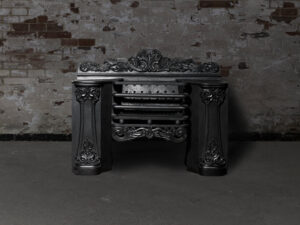 fire is generally not permitted. Only authorised smokeless fuels may be used, or appliances approved for use in smoke control areas.
For many of our clients, this is another reason to pair a period chimneypiece with a gas or electric fire. The surround keeps all of its historic character, while the fire inside is clean, controllable and compliant. If you do have a working chimney, we can advise whether it can be lined and used for a gas fire or an approved stove.
The Practicalities
A few points are worth considering early, ideally while plans are still being drawn up with your architect or designer.
- Weight. A marble or stone chimneypiece can be very heavy. The floor and wall need to be able to carry it, and fixings should be planned with care.
- The hearth. Most fires need a non-combustible hearth in front of them. The size depends on the fire chosen, so it is best decided alongside the surround.
- The opening. The fire must fit the opening of the chimneypiece, or the opening may be adapted. A false chimney breast can be built to house both the fire and its flue neatly.
- Qualified installation. Any gas fire must be fitted by a Gas Safe registered engineer, and the installation should meet Building Regulations.
- Listed buildings. If your home is listed, changes to walls, chimney breasts and fireplaces may need listed building consent.
Bringing the chimneypiece specialist and the fire installer together at the start saves time, cost and disappointment later.
Visit Us on City Road
A missing chimney need not mean a missing fireplace. With the right chimneypiece and the right fire behind it, a room can gain a focal point that feels as though it has always been there.
Our showroom at 193–195 City Road, Shoreditch, holds one of London’s most respected collections of antique marble, stone and metal fireplaces, alongside our bespoke and reproduction designs. We are always happy to talk through your project, whether you are restoring a period house or creating something new.
Call us on 020 7251 8844 or get in touch online. We are open Monday to Friday 10am–6pm, Saturday 12 noon–4pm, and on Sundays by appointment.